Ashutosh Dumbare Indian Police Service
Section 04 Law and order Citizen safety Metropolitan command

Policing the modern city

An account of what metropolitan policing actually consists of — the conditions a large urban force works in, and the demands those conditions place on it. No crime figures are reproduced on this page: statistics are not cited here unless they can be attributed to an official published source.

01  /  The working environment Six dimensions

What a city asks of
its police force

01 — Density

Dense settlement and movement

Indian metropolitan areas combine high residential density with intense daily movement. People commute across municipal boundaries, work in one city and sleep in another, and travel at hours that do not fit a standard shift pattern.

For policing this is a distribution problem before it is anything else: presence has to match where population actually is at a given hour, and response has to account for roads that are not always passable at speed.
02 — Gatherings

Festivals, processions and events

Public gatherings are a defining feature of the policing calendar — religious festivals, immersion processions, political events, sporting fixtures and large commercial gatherings, many with routes and timings fixed by long tradition.

The objective in each case is that the event takes place as intended and everyone goes home safely: route planning, crowd flow, medical standby, communication with organisers, and enough reserve capacity to absorb something unexpected.

03 — Prevention

Prevention and visible policing

Most of a police force’s effect on crime comes before an offence, not after it: patrolling patterns, attention to locations that repeatedly generate incidents, checks on premises, and the ordinary deterrent effect of being present and reachable.

Prevention is also environmental. Lighting, access, transport interchanges and unlit stretches of road determine where people feel unsafe, which is why the police view of a city has to be shared with the authorities that build it.

04 — Response

Emergency response

Emergency response is measured in minutes and in clarity of command. A control room has to receive a call, understand it correctly, dispatch the nearest capable unit, and keep a record that can be reviewed afterwards.

Serious incidents draw in fire services, medical services and the civic administration simultaneously, which is why joint procedure and rehearsed roles matter more than the size of the response.

05 — Digital

Cybercrime and digital harm

Fraud conducted through payment systems, impersonation, investment and job scams, extortion using intimate images, and harassment through messaging platforms now form a substantial part of what citizens report.

These offences cross jurisdictions by default. They require preservation of digital evidence at the first opportunity, lawful process with intermediaries and financial institutions, and investigators trained to read a transaction trail.

06 — Protection

Women’s safety and vulnerable citizens

Safety for women, children, senior citizens and people with disabilities is a test of whether a police service is usable in practice: whether a complaint can be made without intimidation, whether it is recorded properly, and whether the response is timely.

It depends on specific arrangements — trained personnel, appropriate facilities at stations, correct handling of statements, and coordination with support services and the courts.

02  /  Environment Thane

Thane as a policing environment

Thane sits immediately north-east of Mumbai and has developed from a district town into a large metropolitan centre in its own right. It is a place people move to, commute through, and work in — and each of those roles produces a different demand on policing.

The Thane City Police is organised as a commissionerate: a unified command with police stations, zones, a crime branch, traffic and specialist units under one commissioner, who also exercises magisterial powers within the city limits.

Residential growth
Large-scale housing development has extended the built-up area and changed where population density sits.
Commercial activity
Retail centres, offices and services generate footfall, cash movement and their own categories of offence.
Industrial areas
Established industrial and warehousing zones bring goods movement, labour concentrations and site security concerns.
Transport networks
Suburban rail, arterial highways and expanding metro connections move very large numbers of people daily.
Public spaces
Lakes, markets, places of worship and civic spaces host regular gatherings and seasonal events.
Adjacency
Proximity to Mumbai and neighbouring commissionerates makes inter-agency coordination routine rather than exceptional.
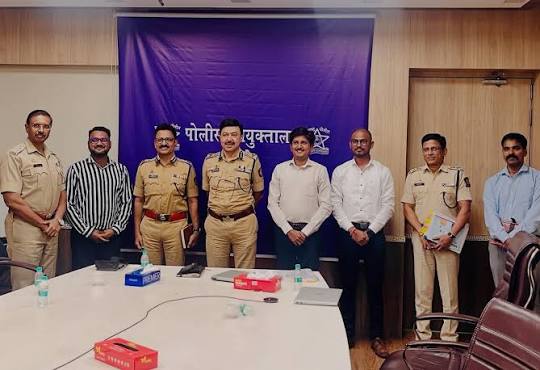
Ashutosh Dumbare with Maharashtra Police officers and officials at a meeting in the Thane police commissionerate.
A coordination meeting at the Thane police commissionerate

Urban complexity is cumulative. Each new corridor, cluster or commercial centre adds demand that does not replace the demand already there. Policing a city of this kind is therefore less about responding to a fixed workload than about continuously re-estimating where the workload has moved.

03  /  Citizens Everyday practice

Citizen-centred policing

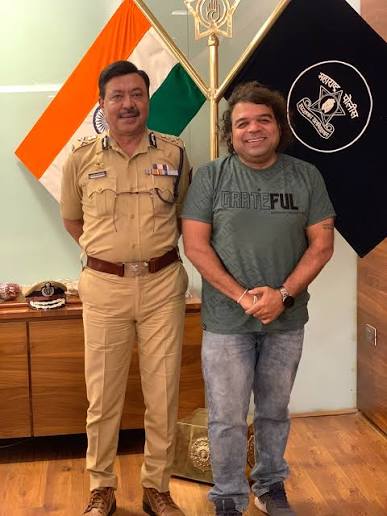
Ashutosh Dumbare in Maharashtra Police uniform standing with a visitor at his office in Thane.
Receiving a visitor at the commissioner’s office

The measure of a police service is not how it describes itself, but how it behaves at the counter of an ordinary police station.

Citizen-centred policing is a set of practical arrangements rather than a slogan. It means a person can find out where to go, is received without having to know somebody, is told what will happen next, and can check on it afterwards. None of that is complicated; all of it requires deliberate attention to survive the pressure of daily workload.

01

Accessibility

Police stations, helplines and online reporting that a person can actually use — including someone who is distressed, elderly, or unfamiliar with procedure.

02

Responsiveness

Prompt acknowledgement of a complaint, and an answer about what is being done with it, without the complainant having to pursue the file.

03

Visibility

Officers who are present in public space and identifiable, so that contact with the police is not limited to moments of crisis.

04

Public communication

Accurate, timely information during incidents and advisories — which also reduces the space in which rumour circulates.

05

Grievance mechanisms

A route to raise a concern about police conduct or inaction, and a record that shows what was done about it.

06

Safety awareness

Public guidance on avoidable risks — particularly online fraud, where prevention is far more effective than recovery.

Next Intelligence

The work that is not visible

Much of what keeps a city stable happens before an incident occurs, and is never seen by the public. The next section explains intelligence, economic offences and anti-corruption as institutional functions.

Beyond the visible